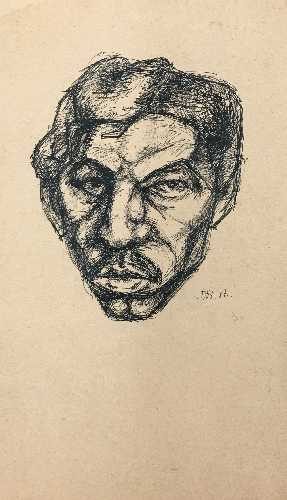
Wilhelm Wulff
Wilhelm Wulff, born Wilhelm Buskühl (April 25, 1891 in Wehringsen near Soest; April 18, 1980 in Soest), was a German painter and sculptor.
Wulff attended the Wood Carving School in Bad Warmbrunn from 1913 to 1914 and the School of Wood Sculpture in 1919. He served in the German Army from 1914 to 1918. As a childhood friend of Wilhelm Morgner and a companion of Eberhard Viegener, Wulff is considered one of the key figures in the Westphalian art scene of the first half of the 20th century.
His early work is characterized by expressionist and constructivist influences. He was friends with Johannes Molzahn during the latter's stay in Soest from 1920 to 1922. For the modern villas Plange (1926), Sternberg (1927), and Jahn (1930) in Soest, designed by Bruno Paul, Wulff created a chimney relief featuring a city view of Soest, which still exists today. After a study visit to Paris in the winter of 1928/1929, he turned to realistic representations. A significant focus of his work consists of public commissions, such as miners' memorials in the Ruhr area.
Werke