Eberhard Viegener
Eberhard Viegener (* 30. Mai 1890 in Soest; † 4. Mai 1967 in Bilme) war ein deutscher Expressionist und Vertreter der Neuen Sachlichkeit sowie ein Landschaftsmaler.
Der aus Soest gebürtige Eberhard Viegener ist als Maler und Graphiker ein Autodidakt. Nach einer Malerlehre arbeitet er im väterlichen Betrieb; regelmäßige Besuche des Folkwang-
Museums in Hagen, bei denen er die Kunst der Moderne entdeckt, wecken in ihm den Wunsch nach einer eigenen Künstlerkarriere. In Zürich, wo Viegener ab 1912 kurzzeitig als Dekorationsmaler arbeitet, entstehen erste eigene Arbeiten, die Anregungen durch Wilhelm Morgner und Ferdinand Hodler offenbaren. Es folgt eine Phase neo-
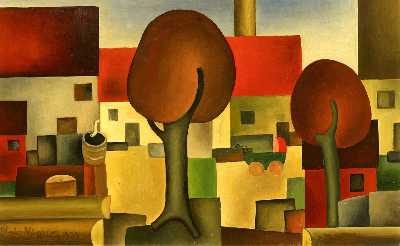
impressionistischen, pastosen Malstils, abgelöst von einer Hinwendung zum Expressionismus, die sich durch frühe Arbeiten Wassily Kandinskys und Alexej von Jawlenskys inspiriert zeigt. Zur gleichen Zeit setzt das umfangreiche druckgraphische Werk ein, vertrieben durch den Galeristen Alfred Flechtheim, der auch die erste Einzelausstellung Viegeners organisiert. In den 1920er Jahren wendet sich der Künstler der Neuen Sachlichkeit zu und malt vorwiegend Stillleben von kühler Formalisierung. Eine realistisch-
naturalistische Malweise kennzeichnet wiederum die Schaffensphase der 1930er Jahre, in der zahlreiche Bilder der heimischen Landschaft Westfalens entstehen, wo Viegener inzwischen zurückgezogen lebt. Gemälde der expressionistischen und neusachlichen Werkphase werden in der Aktion „Entartete Kunst“ beschlagnahmt. Am Ende von Viegeners Schaffen steht die Auseinandersetzung mit dem Kubismus und insbesondere dem Werk Robert Delaunays.
Stilistisch äußerst vielfältig, spiegelt sich in Viegeners Werk die Entwicklung der Moderne wider, deren verschiedenen Strömungen er eigene Akzente zu verleihen wusste.
Werke
Vergangene Ausstellungen
2019 (1 Ausstellung)
- 01.10.2018 – 28.02.2019 Zwischen den Kriegen - Kunst von 1914 bis 1945 · Kunsthandel | Henneken