Else Lohmann
Else Lohmann (* August 29, 1897 in Bielefeld; † June 25, 1984 in Baarn, Netherlands), full name: Elisabeth Emilie Lohmann-van der Feer Ladèr, was a painter of Expressive Realism.
Elisabeth Emilie Lohmann was born on August 29, 1897, in Bielefeld. Her parents were the manufacturer and founder Carl Lohmann (Lohmann Werke AG, a factory for vehicle lamps, bicycle saddles, auxiliary motors, and travel cases) and his wife Fanny, née Bensen. Else Lohmann grew up in a liberal household with four siblings that had a keen interest in the arts and began drawing at a young age. After graduating from Ceciliengymnasium Bielefeld, she attended a girls' boarding school in Dresden, where an aunt lived. In Dresden, she was introduced to modern art movements and discovered the old masters such as Rembrandt, Titian, and Raphael in the city's museums.
For a short time, Else Lohmann returned to Bielefeld and attended the State-City Crafts School there. Shortly after, she moved back to Dresden.
As a woman, she was denied the opportunity to study at an art academy until the end of World War I.
Thus, she could only attend a private painting school. Like many other future female artists (Ilse Heller-Lazard, Florence Henri, Thea Hucke, Minna Köhler-Roeber, Karen Schacht), she studied oil painting with landscape painter Johann Walter-Kurau (1869–1932) starting in 1916 and followed him from Dresden to Berlin after the war ended.
Although the master, originally from Jelgava in Latvia, had a significant influence on her painting style, she soon developed her own expressive style, which was more aligned with Paula Modersohn-Becker or the painters of the Brücke group. Her training period in Dresden was brief, as Walter-Kurau moved to Berlin, where Else later followed him. She enjoyed her life as a painting student in Berlin: “It was a wonderful time. I saw the most beautiful exhibitions and experienced the most significant artists of the time; they all gathered at the Café des Westens in Berlin.” The focus of Walter-Kurau's painting class was on landscape and portrait painting. Many small-format works were created during excursions into nature, primarily in the surrounding area and in the Franconian Switzerland.
In 1921, Else Lohmann traveled to Italy with her mother. In Rome, she met the Dutch art collector Cees van der Feer Ladèr, whom she married shortly thereafter. She brought a substantial dowry into the marriage, allowing them to purchase a representative estate in the Netherlands. Her husband Cees had little interest in modern painting, so the upbringing of their two children and managing a large household became her primary focus.
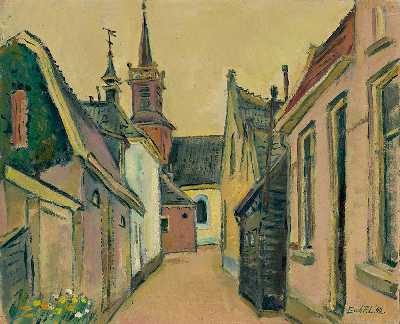
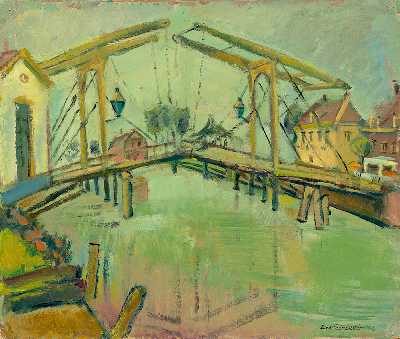
After her husband passed away in 1951, Else Lohmann entered a second creative phase. Many of her paintings were produced during her travels in the Netherlands and southern Europe. She exhibited in galleries and cultural centers in the Netherlands. In her native Germany, she was discovered only late in her life. In Bielefeld, an exhibition of her works took place in 1980 at Galerie Jesse, which she attended. In 1983, her paintings were featured in a group exhibition at Kunsthalle Bielefeld. A year later, Else Lohmann passed away on June 25, 1984, in Baarn, Netherlands.
In the 1990s, many female artists of her generation were rediscovered. The Verborgene Museum in Berlin dedicated a solo exhibition to her in 1991. On the occasion of the art exhibition celebrating the 140th birthday of Johann Walter-Kurau, works by his female students Else Lohmann, Minna Köhler-Roeber, Ilse Heller-Lazard, and Eva Langkammer were shown alongside his works in Jelgava/Latvia and Berlin in 2009.
She left behind an extensive, uncataloged body of work consisting of several hundred paintings and sketches, which are distributed around the world. Some significant pieces from her estate remain in the possession of the Lohmann/Heise family.
Werke
Past Exhibitions
2019 (1 Ausstellung)
- 01.10.2018 – 28.02.2019 Zwischen den Kriegen - Kunst von 1914 bis 1945 · Kunsthandel | Henneken