Der Umweltschrei geschlossen
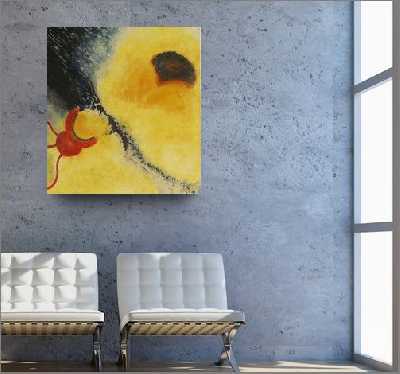
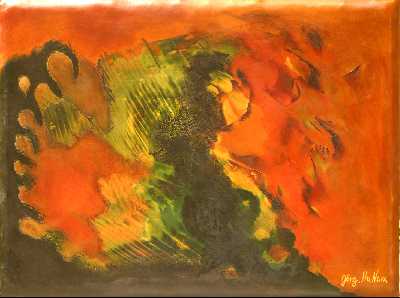
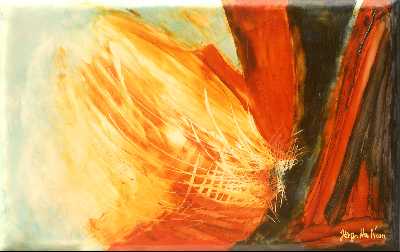
The painting "The Scream Environment" shows the abstract distorted, screaming face of a woman. A Vietnamese woman. A Vietnamese seamstress. Perhaps remind the viewer of their trains Munch's famous "The Scream." The resemblance is coincidental. This is the genesis of the "environmental cry":
His painter, the German artist, designer and eco-textiles specialist Hans-Jörg Hamann is a volunteer for many years in Ha Nam, near the Vietnamese capital of Hanoi, on with his development and design team at a total solution for denim finishing biological basis - as an ecological alternative to conventional denim finishing, which is the largest textile environmental sin of our time. For several years, Hamann is supported by Germany and the Lohas.de jeans specialists Conrad Buck.
Hamann for the first time as it was possible to use organic painting materials in denim finishing and reclaim a small ceremony was held. During a conversation with a Vietnamese seamstress whose husband earns his living as a river fisherman, sobbed the otherwise very quiet woman suddenly and deeply unhappy. Hamann was very touched and asked the translator about the reason for the bitter tears that cause unhappiness.
The seamstress told him that she needed help with their work in a jeans factory to support the family. This was necessary because her husband earn the river fishing less from week to week. But exactly the jeans factory is, so on the seamstress, to blame for increasingly fetid and half dead fish in the nets and traps her husband arrived. A vicious circle, whose resolution the seamstress had not imagined - at least not for their life time. Hamann's new wastewater-free 100 percent denim finishing technology bring you hope.
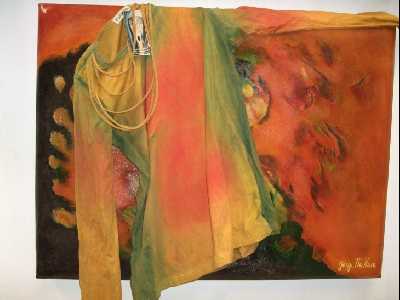
Long before the painting was finished, had Hamann called it "The environmental cry". It was the hallmark of the eco-fashion project in Ha Nam and fully painted with colors recovered from the jeans-processing plant on raw cotton.
The technology:
As the developer of the purely biological matrices and textile auxiliaries for finishing of jeans that can be produced with totally effluent-free, to know the painter Hans-Jörg Hamann of natural reactions, the almost living properties and the interaction of the materials well.
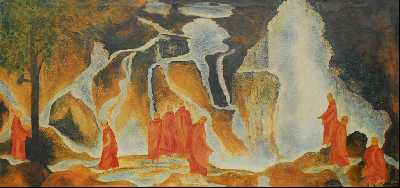
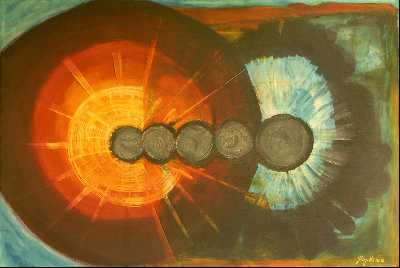
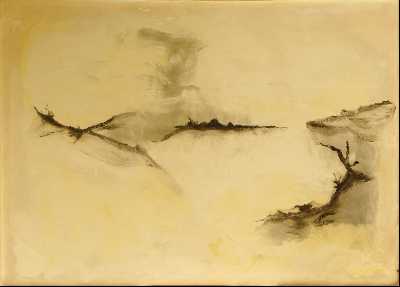
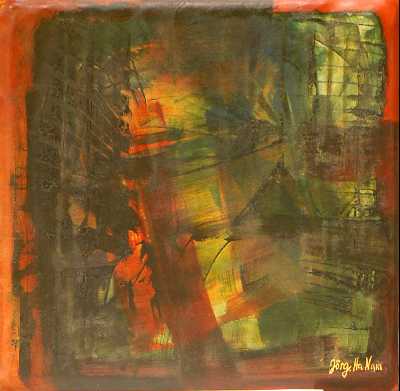
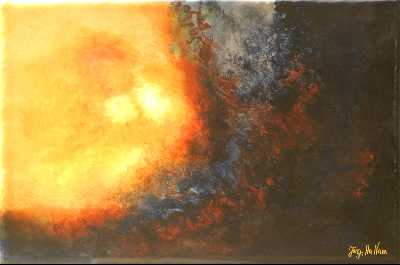
Thanks to the natural colors of the unique artist succeeds Hamann, images of nature, abstract or representational, capture and hold al s snapshot - almost as vivid as the natural model. Dealing with the new time-materials is an art, Hamann has made him in his paintings to art.
An art in harmony with nature, by the way, is also aware of the painter as such and makes use. Nature forms eventually own effects, they obviously change from day to day. The artist must decide which moments he holds as well as the location and participate in the painting can be.
The unique eco-painting want with their motives not only evoke emotion, but also give the viewer a new art form with its own contingent of the matter characteristics. In order to achieve a completely homogeneous and true naturalness, the entire basic level to be 100 percent, of course.
Hamann therefore primed the canvas, a fabric made of 100 percent cotton, even though this is standard practice in conventional painting. He achieved thanks to the natural Malgrunds that the biological effect of these pictures can permeate the entire work - both from behind and from the front.
Even if all the matrices of the recovered, biological textile auxiliaries for example would easily be mixed with acrylic paints, the desired biological effects and features for such a mixture would no longer be possible. Only to perpetuate the most beautiful moments of an image requires the artist chemical helper, such as a transparent coating that is applied to the front penetrates the painting materials and painting the canvas completely fixed.
An art in harmony with nature, by the way, is also aware of the painter as such and makes use. Nature forms eventually own effects, they obviously change from day to day. The artist must decide which moments he holds as well as the location and participate in the painting can be.
The unique eco-painting want with their motives not only evoke emotion, but also give the viewer a new art form with its own contingent of the matter characteristics. In order to achieve a completely homogeneous and true naturalness, the entire basic level to be 100 percent, of course.
Hamann therefore primed the canvas, a fabric made of 100 percent cotton, even though this is standard practice in conventional painting. He achieved thanks to the natural Malgrunds that the biological effect of these pictures can permeate the entire work - both from behind and from the front.
Even if all the matrices of the recovered, biological textile auxiliaries for example would easily be mixed with acrylic paints, the desired biological effects and features for such a mixture would no longer be possible. Only to perpetuate the most beautiful moments of an image requires the artist chemical helper, such as a transparent coating that is applied to the front penetrates the painting materials and painting the canvas completely fixed.
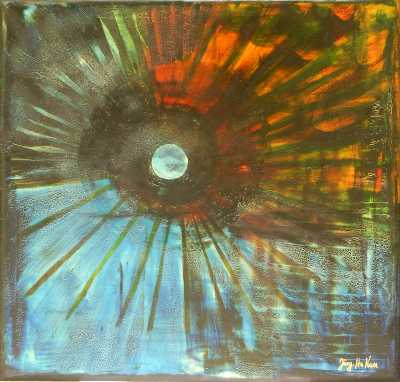
Acrylic admixtures would immediately identify them as such, if you have a picture from its back illuminates. The biological color mixtures however have a natural transparency, so that even generate superimposed layers of paint a different kind, yet in painting unprecedented depth. Lying on top of layers of paint underneath does not cover, as it is known in the art acrylic or oil, but go with the lower classes, a bond. That means not a "paint over" unwanted brush strokes works! The painter has his artwork from the first attachment of the brush or spatula and thought have the desired effects can be achieved deliberately.
All images
Represented artists
Past Exhibitions
2013 (2 Ausstellungen)
- 18.03.2013 – 12.08.2013 Der Umweltschrei
- 17.02.2013 – 18.03.2013 Der Umweltschrei
2012 (4 Ausstellungen)
- 10.05.2012 – 30.12.2012 Der Umweltschrei
- 25.05.2012 – 30.12.2012 Der Umweltschrei
- 20.11.2012 – 30.12.2012 Der Umweltschrei
- 08.12.2012 – 30.12.2012 Der Umweltschrei