Roselyne Titaud
In a Labyrinth of Fictions
The photographs of Roselyn Titaud collect the home for us. The home for all practical conversations is a space or the site where the relationships and rituals of a family are enacted, performed, constructed and lived. Titaud changes this for us in the way she quotes the corners of living spaces in her photographs. She in a way discovers the facts of the home. The phenomenology of home as concrete space or as the site of and for a particular experience is culled out in the sets of objects that linger on in the physical space. The lingering object, and essentially the orchestrated play of these lingering objects, forms the crux of our experience of home and family.
As light filters through the lace curtain and evenly fills the room with a heavenly ambience the pavilion with its trees as references to a distant oriental or Dutch landscape animate the space. The view inside the room begins to complete a picture with the lace table-cloth and its geometric-floral patterns with fruit bowls, walnuts in a wooden platter, painted pottery, and classic teakwood and leather chairs, along with another curtain with black streaks as if on the coat of a tiger. Well, there is also the mosaic-finish on the walls. On another occasion one sees the view inside the room where you have… a settee with a velvet-finish cover of brown background with orange maple leaves, a blue hand-rest, a plain brown back, a red, black and white patterned cushion-cover, a landscape poster, a glass shelf bracket with a lace cloth on it, holding a vase containing red and yellow plastic flowers, an empty cylindrical vase, and a curio.
Every picture that Titaud frames there is a dual act – one, where the objects come together as if it is the most obvious thing for them to be there, making the space of home and living, carefully put or the many moments of chance that have accumulated these objects in that organized and choreographed manner; but on another note the individual-ness and the unrelated-ness of one object in this collage with the other/s is apparent. This coming together of 2 opposite understandings in the same viewing is the crucial aspect of Titaud’s photographs. As much as the sentimentality of living in a home and its projection of a family are contained in these pictures, they do also deconstruct the image and formula of that space of emotion. Random objects and their shared memories construct that emotion, which often borders on the sentimental. Most of these objects have a shared memory, and an imagined emotion, which together make the home.
The home is defined against that which is supposedly outside it, i.e. the space of the world outside – the space of work, play, market, etc. that which is public. Often the space of the home then becomes an endeavor to reconstruct that outside world inside a confined physical limit of the house or apartment. This is a world that contains not only ourselves but other selves from the world, who or which are now domesticated as against the uncertain, unpredictable and ambiguous nature of these very objects in the ‘wild’ world outside. It also becomes a space of reconstructing reminiscence and denials – what is of the world that one wishes to recollect and hold inside the house as the holder of desire or fear. The home is then the haven, a kind of doll house that can be stored with objects that apparently have a clear form and purpose, but underneath contain narratives of the home that posses it. These objects are allegories of those who compose them. Titaud’s photographs capture precisely these allegories. Rather than operating as a photographer, she in some way performs the act of magic, like the fantastic crystal-ball reader of the ‘east’ who can capture, in this case the narrative of home and life.
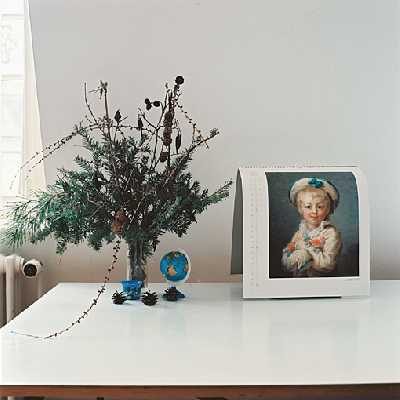
Her photographs have no human beings, but their performances and their actions are so strongly present that their absence-presence is literally surreal. So once the image has done its job of presenting the ‘sweet-home’ it sets forth to understand the ‘interior’, the very-defined enclosed and contained frame of the ‘inside’. As much as her photographs of the beds in the studios of Akademie Schloss Solitude indicate the immediate-ness of an absence, her earlier images are capturing the time between the performance and the waiting - the performance of ‘home-making’ and the waiting of a ‘user’. However the images of the crumpled yet silent bed, the folded yet anxious cover-sheet of the bed as well as the vase in the corner, or the lace centre-piece on the dining table seem calm and composed, as if their purpose was to be in that in-between space, now they are at peace, not being used, but performing the memories, anxieties, and reminiscences of a constructed life-space.
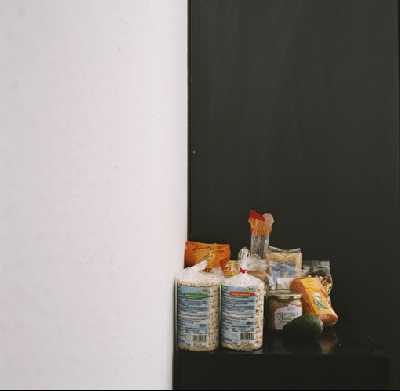
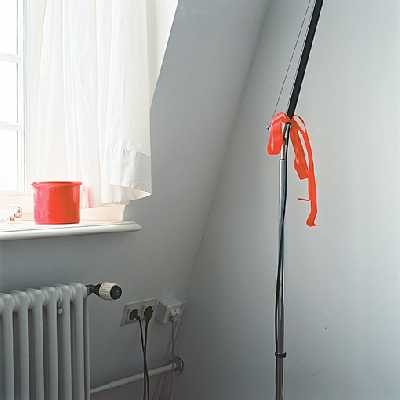
As the lens starts focusing on the studios in Akademie Schloss Solitude, the same photographic endeavor reveals the working space of artists and academicians, where mostly single individuals use the studio to live and work for short durations of 3-12 months. The in-between home, the working space that also doubles up as the home is tense about being the ‘home elsewhere’ while also the space now of an artist anxious of the way he or she deals with life. The frame captures objects once again; however these objects just seem to miss the choreographed nature of the earlier pictures. There is a further randomness in the collection of these objects and hence the frame. Titaud’s framing now includes the personal more sharply. The abstract yet composed objects that framed the home earlier are now replaced by single or fewer objects located in a space-context; while her earlier pictures framed the space per se with the objects central as the characters of that play now the space itself is probably one of the objects alongside others. The assorted objects are obvious in this case, they do not presume a strong narrative, but now they are the collage they resemble of the one at ‘home’ or of an imagined home.
The narrative is constructed through the construction of an ornamented spatiality. The objects ornamental themselves come together to heighten the experience of that which is embellishment and flourish and hence ornamental. The ornamental in this case leads in a concrete way towards establishing a fixed notion of home and the world. The ornamental in the case of the artists’ studios at Solitude is contained in a sense of ‘collection’. The collected objects try and piece together a narrative, but it is actually their joints that are there to observe, and they are not lost in the narrative. Titaud has the capacity to not only sense these aspects but also be able to frame it, frame the ‘sense of space’ rather than simply framing objects and their collective settings. What Titaud begins to do in her earlier photographs of the home, reaches an ontological expression even sharper now in the pictures at the Akademie.
As much as her photographs contain objects in a self-complete way, there are also objects that are within the frame only partly. They have entered the frame incomplete or they indicate the continuity of that frame elsewhere; in either case, the finality of frame that Titaud’s photographs indicate is always running away to, or waiting for, some other ideal and larger frame elsewhere. Again here Titaud is playing out the sense of object-subject relationship, the objects she has framed, and however universally recognizable they are they seem to exist in specific subject-conditions of the very specific space that the picture belongs to. That vase and that wall-paper, or the curio and tablecloth belong to every home, and yet they are their owner’s very personal objects.
The range of Titaud’s work indicates her concern with two concepts very clearly, the object-hood of things and the sense of a collection. Looking at dry aquariums or cemeteries, the same act is performed with very different valences. Her pictures of the studios at the Akademie bring a specific interjection as to how space is perceived and understood, how the space is performed with the sense of collected objects, and defined personally through performed collections. Within the details of these conversations between object-hood and collections, and being proposed in different locations – home, studio, aquarium, cemetery, the aspects of culture’s location in emotion and sentimentality is emerging intriguingly. A set of people defined by practice, cultural imagination, nationality or a believed common history invest always in a space of emotion, but always with a more epistemological or aesthetic argument, and Titaud’s photographs are crucial in helping us dissect and investigate these behaviors and habits of people and cultures.
By Kaiwan Mehta
Werke
Past Exhibitions
2011 (1 Ausstellung)
- 12.05.2011 – 11.06.2011 Solitude - Alltäglich · Kunstraum Denkpause