Ivo Hauptmann
Ivo Hauptmann (* 9. Februar 1886 in Erkner bei Berlin; † 28.
September 1973 in Hamburg), ältester Sohn von Gerhart Hauptmann, war ein deutscher Maler. Er war Mitbegründer der Künstlergruppen Freie Secession (Berlin 1914) und Hamburgische Sezession (1919).
„Maler sein bedeutet glücklich sein im wahren Sinne, denn jede geliebte Tätigkeit bedeutet Glück“, dieses Fazit zog Ivo Hauptmann bei seinem 85. Geburtstag. Glück, eine gewisse Heiterkeit, das Lebensbejahende spricht aus seinem gesamten Werk. Es spricht aus der duftigen Palette der Farben, es spricht aus dem bewegten, doch präzisen Pinselstrich, es spricht aus der Thematik seiner Bilder. Als Sohn des berühmten Dichters Gerhart Hauptmann dieses Glück in einem künstlerischen Beruf zu finden, ist keine Selbstverständlichkeit. Aber im Gegensatz zu vielen Vätern förderte der Dichter die sich schon früh zeigende künstlerische Begabung des Knaben, der von sich behauptete, mit sechs Jahren sei er Maler geworden. Der in Erkner bei Berlin geborene Ivo reiste schon im Alter von 14
Jahren mit dem damals 26jährigen schlesischen Maler Otto Mueller, einem entfernt Verwandten, zum Malen und Zeichnen an die Riviera. Drei Jahre später war Ivo bereits in der Gesellschaft von Graf Harry Keßler, dem Direktor des Museums in Weimar, und von Ludwig von Hofmann, dem Leiter der Weimarer Kunstakademie, bei einer Reise nach Paris. Dadurch lernte er die Avantgarde in der französischen Hauptstadt kennen: Denis, Maillol, Bonnard und Vuillard. Er ließ sich in der Académie Julian bei Lefebvre einschreiben und kam dadurch in Kontakt mit der Kunst Gauguins und lernte den Cloissonismus kennen, jene flächige Malerei, die kräftige Farbfelder mit betontem Kontur umschließt. Mehr noch scheint er jedoch vom Pointillismus beeindruckt zu sein, der besonders von Paul Signac gepflegt wurde. Nach dem Parisaufenthalt studiert Ivo Hauptmann kurze Zeit in Berlin bei Lovis Corinth und geht dann nach Weimar, wo er auf Henry van de Velde, Eduard Munch und Hans Arp stößt. Den Studien in Weimar folgt ein zweiter, jetzt vierjähriger Aufenthalt in Paris. An der Académie Ranson zählen Bonnard,
Denis, Maillol sowie Serusier und Signac zu seinen Lehrern.
In Paris stellt Ivo Hauptmann recht erfolgreich im Salon der Société des Arts Indépendents Zeichnungen und Aquarelle aus.
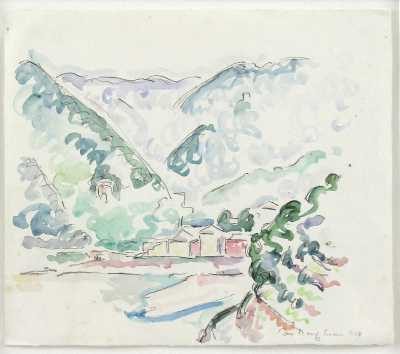
Ivo Hauptmann bleibt sein Leben lang dem Gegenständlichen treu. Ihn interessiert die Landschaft, doch auch als Porträtist leistet er Hervorragendes. Immer wieder malt er Stilleben entweder als selbständige Bilder oder als Vordergrund einer Landschaft, eines Porträts. Ivo Hauptmann zählt zu den wenigen deutschen Künstlern, die den Pointillismus beherrschen und ihn in eine durchaus eigene Handschrift umgesetzt haben. Schon 1923 würdigt man das im bedeutenden Künstlerlexikon Thieme-Becker. Dort kann man lesen: „Hauptmann weiß mit der Technik des Pointillismus oft feinste malerische Reize zu erzielen, lichtdurchflutete Lufträume mit weiten Fernen von prachtvoller Transparenz und in der Sonne zitternde Wasserflächen wiederzugeben.“
Einer pointillistischen Frühphase folgt etwa ab 1914 eine expressionistisch geprägte Schaffensperiode, für die wohl die enge Freundschaft mit Otto Mueller und Eduard Munch verantwortlich gemacht werden darf. Die Flächen verdichten sich, die Konturen werden hart und bestimmend.
1913 siedelte Ivo Hauptmann nach Hamburg über, 1919 ist er Mitbegründer der Hamburger Sezession. In den 20er Jahren erfolgt ein Rückgriff auf seine neoimpressionistische Malerei der Frühzeit, die eine Synthese mit der seiner konturbetonten, expressiven Phase eingeht. Daraus entwickelt Ivo t Hauptmann in den 30er Jahren eine sehr eigene Handschrift und vereinigt subtile, dabei aber starkfarbige Malerei mit klaren, rahmenden Konturen. 1933 erlebt Hauptmann die Schließung der Hamburger Sezession, wird aber selbst nicht vom Malverbot betroffen. Dennoch arbeitet er im Stillen. Als 1945 die Hamburger Sezession wiedereröffnet wird, greift er dankbar die Gelegenheit auf, den Vorsitz zu übernehmen, dankbar auch die Gelegenheit, an der Hochschule für Bildende Künste einen Lehrauftrag zu übernehmen. Seine künstlerische Leistung wurde nun gewürdigt, so durch die Verleihung des Edwin-Scharff-Preises und durch die Ernennung zum Ehrenpräsidenten der Freien Akademie der Künste. 1972 wurde ihm für seine langjährige Tätigkeit als Dozent an der Kunstakademie der Professorentitel verliehen. Ab Mitte der 50er Jahre waren einige große Retrospektiven von Ivo Hauptmann in deutschen Museen zu sehen, so in Stuttgart (1954,1966), Hamburg
(1966), Regensburg (1966) und Berlin (1973), und machten ihn einem breiten Publikum bekannt.
Werke
Vertreten durch
- Galerie Hans Brockstedt OHG · Berlin
- Galerie Herold · Hamburg
- Galerie Koch-Westenhoff · Lübeck
- Kunsthandel | Henneken · Bad Iburg